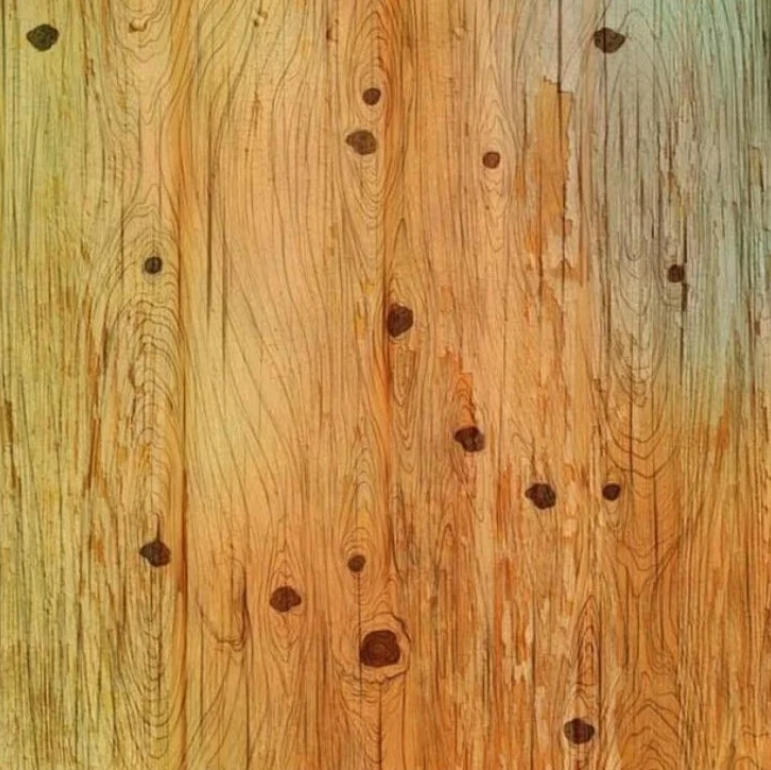
In certain spots, those lines swirl into dark, irregular circles.
We call these knots.
They are the naturally dark marks where branches once grew out from the tree trunk.
And this is where your search begins.
The knots are the key players in this optical illusion.
They are the perfect decoy.
You are not looking for a realistic portrait of a fluffy golden retriever or a playful poodle.
You are looking for a shape that has been cleverly created by the texture itself.
This dog isn’t painted on the wood; it is the wood.
Its entire form is a masterpiece of negative space and clever alignment.
It’s about seeing faces and patterns in random places—a mental ability called pareidolia.
And it’s fascinating how our brain can be tricked by it!
Try this technique: lean back from your screen.
Blink a few times to reset your focus.
Now, instead of looking for the dog’s eyes, look for the edges of its body.
The dog might be smaller than you think.
Or maybe it’s bigger, taking up a whole segment of the image?
I can’t give you any more hints, because where’s the fun in that?
The moment you see it, you’ll likely ask yourself, “How did I miss it?”
It’s an excellent little exercise in mindfulness, forcing you to slow down and really process what you’re looking at.
This riddle has stumped some very sharp people.
But don’t give up!
Keep shifting your gaze.
Look at the image from different angles.
It’s definitely there, patiently waiting for its big reveal.
So, tell me: Are you a member of the elite club who can spot it in under ten seconds?
Or are you, like most of us, still squinting and searching?
Good luck, and happy hunting!
ANSWER: