Every night, my son showered at 3 a.m., and I kept convincing myself it was just stress, until curiosity compelled me to look through the bathroom door and see something so terrifying, so familiar, and so evil that I left his house for a nursing home before dawn… but I couldn't leave her behind…
I'm 65 years old. I moved to the city to retire with my son. Every night, at exactly 3 a.m., he showers. One night, driven by curiosity, I peeked in, and what I saw in that bathroom scared me so much that the next day I moved into a retirement home.
Hello everyone, and welcome to the Solar Stories channel. I'm 65 years old, and after retiring, I moved to the city to live with my son. Every night at 3 a.m., he showered. One night, out of curiosity, I peeked inside. What I saw in that bathroom terrified me so much that the next day I moved into a nursing home.
In the small town of Pine Hollow, where I had spent my entire life, the late autumn wind brought with it the dry chill of early winter, penetrating sharply into every corner of the house.
My name is Neala, and at 65, I had just officially left the chalk dust of the high school classroom where I had taught for decades.
That old Victorian house had seen most of my life, from an enthusiastic young teacher to a widow, and now to an old woman whose hair was frosted with time.
On the mantelpiece, a photograph of my late husband, Samuel, still stood there, serious and dignified.
The thought of him stirred a complex feeling in my chest, a mixture of sadness and relief for a weight that had finally been lifted.
It is often said not to speak ill of the dead, but the invisible wounds that his beatings and cruel reproaches had left in my soul have never disappeared.
He had been a violent and authoritarian man, who had always treated me and our son as objects of his exclusive property.
The day he found out he had terminal cancer was the same day our son, Nicholas, received his acceptance letter to a prestigious state university.
I put aside all rancor and resentment to care for him until his last breath, not out of love, but out of a sense of duty, so that Nicholas could concentrate on his studies.
The day my husband died, I didn't cry once.
I suddenly felt a weight lift from my shoulders, and from that day on, my son and I had only each other.
I devoted all my love and energy to her growth, even accepting extra private lessons in addition to teaching to help pay for her studies.
As a child, Nicholas had been intelligent and determined, but he also had a short temper, perhaps a trait inherited from his father.
Every time I saw him frown and raise his voice, a silent fear crept into my heart.
I tried to guide him with all the sweetness of a mother, hoping to smooth out the rougher edges of his character.
In the end, Nicholas didn't disappoint. He graduated with honors, quickly found a good job in a big city, and eventually rose to the position of regional director for a well-known company.
He married a sweet, kind-hearted woman named Hazel.
Finally, the heavy burden that had been weighing on my shoulders seemed to lighten, and I believed that from then on I would enjoy a quiet and peaceful life, tending to my rose bushes in the morning and walking with the other old women of the village in the evening.
But life rarely follows the path we imagine.
That day I was busy in the garden when the phone rang. It was Nicholas.
“Hey, Mom, what are you doing now?”
Even in a simple greeting, his voice always conveyed a slight tension.
I wiped my dirt-stained hands on my apron and laughed softly.
“I was checking on the roses, and they're almost ready to be pruned, so is there something wrong, son?”
“Mom, Hazel and I talked about this, and I want you to pack your things because I’m coming to pick you up this weekend in my car and take you to the city to live with us.”
I stood there, and the thought of leaving that place, of abandoning the quiet life I knew so well, made my blood run cold.
“Oh, no, son, because I’m used to living here and I don’t know anyone in the city, so I wouldn’t feel comfortable and I’d just be a burden to you and your wife.”
“What problem are you talking about, Mom?”
There was a certain impatience in Nicholas's voice.
"It's a son's duty to take care of his mother. Besides, what if something happened to you out there, all alone in the countryside? Who would ever know? I've already made my decision, so please don't argue; we've already prepared a nice room for you."
His tone sent shivers down my spine, as it sounded exactly like my late husband's, but I still tried to gently refuse.
"Nicholas, darling, I know you care about me, but I'm really too old to change my surroundings. I won't have any friends there, I won't have a garden, and I'll be bored to death."
“What do you mean, 'friendless'? You'll come with us, and Hazel can take you shopping and show you around. Here, I'll let you talk to Hazel for a minute.”
The line was silent for a moment, then a clear, sweet voice came through, like fresh spring water flowing through the tense air.
“Mom, my name is Hazel.”
“Oh, hello, dear,” I replied, softening the tone of my voice.
"Mom, please come live with us. Our apartment is spacious, and with you here, things will be much more lively. Nicholas is always worried about your health and can't relax knowing you live alone, so you can come here and I'll take care of you. We can chat, and it will be wonderful, Mom."
Hazel's voice had a strange power of persuasion, and her warmth and kindness made it difficult for me to refuse.
I knew the girl had a good heart, but I could still sense the obedience beneath her words, as if the decision had come from Nicholas and she had no choice but to carry it out.
I sighed and was silent for a long time, my mind transformed into a battlefield.
On one side was the freedom and peace I had so longed for after so many storms, and on the other was duty, my love for my son, and the fear that if I refused, Nicholas would lose his patience.
I was afraid of his anger, because I had once lived in a hell of anger and I didn't want to face it again.
“Okay, then,” I finally relented, “let me pack my bags for a few days.”
“Oh, how wonderful! My husband is coming to pick you up this weekend,” Hazel said, her voice filled with joy.
After I hung up, I sat quietly in my garden and, over the next few days, began packing.
I didn't own much, just a few old clothes, a faded photo album, and a few books I really liked.
As I flipped through the pages of the album and looked at the photos of Nicholas's radiant smile as a child, my heart softened again.
Maybe I was thinking too much. He was my son, the boy I'd raised with my own hands, and he was bringing me to live with him because he was worried about me and felt it was his responsibility.
“I should be happy,” I told myself.
I put away my past, half a lifetime of memories, and prepared for a new journey, saying goodbye to my neighbors and old friends with whom I had shared morning and evening conversations.
Everyone was happy for me, saying how lucky I was that my son was taking me to the city to care for me in my old age, and I just smiled, even if the smile wasn't complete.
That weekend, Nicholas arrived in a sleek, black sedan, and when I saw my son in a tailored suit, looking every inch the part of a successful man, I felt indescribable pride.
He moved around busily, helping me with my belongings and repeatedly asking if I was comfortable.
Hazel accompanied him, and the warm family atmosphere swept away, at least temporarily, my uneasiness.
“Mom, look, I bought you a couple of things,” Nicholas said, opening the trunk to reveal several boxes of expensive vitamins and supplements.
“Oh, you shouldn’t have spent all this money, I don’t need anything,” I scolded him affectionately.
"I don't lack money, Mom, just the time to take care of you. I can only work peacefully if you live with us," he said sincerely.
The car drove away, leaving behind the town, the old roof, and the familiar garden. On the wide highway, the skyscrapers slowly rose before us like giants.
The noisy, crowded energy of the city made me feel a little overwhelmed.
Nicholas and Hazel's apartment was on the 18th floor of an elegant residential building, much larger than I expected, with polished wood floors and sumptuous furniture that bespoke wealth and luxury.
Nicholas escorted me to a small but fully equipped room, with a window overlooking a lush green park.
“This is your room. I had a TV and air conditioning installed for you, and if you need anything, just ask Hazel, so don't hesitate to contact me.”
“That’s wonderful, son, and thank you both so much,” I said.
Hazel carefully helped me put my clothes away in the closet. That girl was always like that, always busy, always with a sweet smile.
But I noticed that whenever Nicholas was around, her smile seemed a little forced, and a flash of caution and fear crossed her eyes.
The first dinner seemed pleasant on the surface. The meal was hearty and full of all my favorite dishes.
“Mom, eat more, you’re too skinny,” Nicholas said, putting a large piece of fish in my bowl.
“I can get it, you eat,” I replied.
“Hazel, aren’t you going to get another helping of soup for Mom while you’re sitting there?”
He turned to his wife, and though his voice wasn't loud, it was full of authority.
Hazel gasped and quickly served me some soup. I saw her hand tremble slightly, but I pretended not to notice and smiled at her.
“Thank you, dear, and the soup is delicious,” I said.
Throughout the entire meal, Nicholas talked almost the entire time. He spoke about work, important projects, the competitive pressure, and described his successes without any modesty, with pride and satisfaction.
Hazel and I just sat there listening, nodding every now and then.
Suddenly, I realized that my son was no longer the child who needed my protection. He had become a man of the world, a man of power, and he had brought that power into his home.
That night, lying in the soft, unfamiliar bed, I tossed and turned, unable to sleep. The sounds of the city filtered through the window: distant car horns and the faint murmur of people talking.
Everything was new and everything made me feel uncomfortable.
I tried to reassure myself that everything would be fine and that I just needed time to adjust.
In the first few days of living in my son's luxurious apartment, I believed my worries had been unfounded. The new life wasn't as stifling as I'd imagined.
On the contrary, he seemed permeated with sincere concern.
In the mornings, after Nicholas left for work, Hazel often took me to the farmers market. She wouldn't let me bring anything and always asked me what I wanted to eat.
He patiently listened to my rambling tales of my teaching years and my former students. Sometimes he took me to a large shopping mall and bought me some new clothes, despite my repeated protests.
“Mom, it looks great on you,” she would say with a sweet smile and a clear look, telling me that Nicholas would be delighted to see you wear it.
Nicholas also acted like a devoted son. Every evening, after returning from work, no matter how tired he was, he always came into my room to check on me.
“Mom, how are you feeling today? Do you need me to buy you more supplements?”
He bought me an electronic blood pressure monitor and explained everything to me carefully.
“Mom, you need to measure it twice a day, once in the morning and once in the evening, and ask Hazel to write it down in this notebook so I can check it.”
But that peace, I later realized, was only a surface layer.
It happened one night toward the end of the month, about two weeks after I moved in. The city was already asleep, and only the faint glow of the streetlights filtered through the window.
I've always been a light sleeper, often tossing and turning until late at night.
When the wall clock struck three sharp strokes, I was suddenly jolted awake by a familiar sound occurring at an unusual hour: the rush of water.
It was the shower in the master bathroom, the one right next to my bedroom. The roar of the running water pierced the deep silence of the night.
“Who would ever shower at 3 in the morning?”
I listened carefully, but there were no other sounds, just that solitary, rhythmic splash of water.
Might Nicholas or Hazel be feeling unwell and need a bath?
A thin thread of worry crept into my heart. I wanted to open the door and check, but I was afraid I'd disturb them.
The water ran for about 15 minutes, then suddenly stopped and the apartment went silent again.
That night I couldn't fall asleep again.
The next morning, at breakfast, I tried to act as naturally as possible.
“Nicholas,” I said, looking at my son, “were you feeling unwell last night, because around 3 a.m. I heard someone taking a shower?”
Nicholas was reading the newspaper, never taking his eyes off the page.
“Oh, nothing, Mom,” he replied nonchalantly, “this new project has been really stressful and I was feeling nervous and restless, so I just got up to take a quick shower to freshen up so I could go back to sleep.”
Her explanation seemed believable, but at that moment I saw Hazel, who was carrying a bowl of oatmeal from the kitchen, freeze for a moment, and the chopsticks she was holding almost slipped.
She quickly regained her composure, put the porridge on the table and smiled as she explained the situation to her husband.
“Yes, Mom. He’s been working so hard lately and tossing and turning all night, so don’t worry.”
My daughter-in-law's brief moment of panic didn't escape me. As a teacher with decades of experience, I've always been sensitive to unusual expressions.
Something wasn't right, but I didn't press the issue. I just finished breakfast in silence.
I thought it was an isolated incident, but I was wrong. Two nights later, at exactly 3 a.m., the noise returned.
It was the same sound as a faucet being turned on abruptly, followed by the steady, rushing flow of water.
This time, an inexplicable shiver ran down my spine.
Taking a shower in the middle of the night due to stress might have been believable once, but for it to happen again at the exact same time was no longer a coincidence.
The nights that followed were nights of waiting for that sound. As 3 a.m. approached, my heart beat faster and faster.
Sometimes the water would begin to flow, other times a chilling silence would fall. This unpredictable strangeness turned into a kind of psychological torture.
My sleep became fragmented. I was always half asleep, listening intently for any sound, and I began to keep a closer eye on my son and daughter-in-law.
During the day, Nicholas continued to go to work as usual and appeared normal, but sometimes I noticed tiredness and irritability in his eyes, and he got angry more easily over small things.
I tried to ask my daughter-in-law cautiously.
“Hazel, is there something wrong? You haven’t seemed well lately, and has Nicholas done something to you?”
He got scared, then waved his hands rapidly, avoiding my gaze.
“No, nothing, Mom. I'm probably not sleeping well. Nicholas is very kind to me.”
His words and expression were in complete contradiction, and I knew he was hiding something.
A vague fear began to form in my mind, a fear linked to Nicholas and those downpours at three in the morning.
I couldn't take it anymore, so I decided I needed to have an honest talk with my son again.
I chose a time after Hazel had put the baby to sleep, when it was just the two of us in the living room.
“Nicholas, sit down, I need to talk to you,” I said, patting the sofa beside me gently.
He seemed surprised by my serious expression, but sat down.
“What's up, Mom?”
I took a deep breath, trying to keep my voice calm.
“Son, listen to me. I know you're very stressed at work, but you can't continue with this habit of showering at 3 a.m. I've done some research, and that's the time of night when your body's energy is at its lowest and your temperature is lowest, and showering at that hour is very dangerous. At best, you could catch a cold, but you could also have a stroke or even die of heart disease. You're young, with a bright future ahead of you, so you need to learn to take care of your body.”
I blurted it out in one breath, with a mother's concern. I thought he'd listen, or at least explain himself more clearly, but he didn't.
Nicholas's face darkened and his usual patience vanished, replaced by open irritation.
“Mom, enjoy your retirement and stop meddling in my business.”
The bedroom door closed with a loud thud, a final and definitive statement that put an end to any attempt I had to show concern.
Nicholas's cold refusal and the slammed door felt like a bucket of icy water. From that day on, the atmosphere in the house felt as heavy as lead.
Nicholas barely spoke to me. He avoided my gaze and treated me as if I were invisible.
It was then, when my attention was diverted from the strange noises of the night, that I began to notice the other person trapped in this silent tragedy: my daughter-in-law, Hazel.
One afternoon, we were chopping vegetables together in the kitchen. As Hazel reached for a basket from the top cabinet, the sleeve of her soft blouse slipped down, exposing her pale wrist.
What I saw was a blur of purple and blue mixed with a pale yellow, clearly imprinted on her delicate skin.
The shape of the bruise was strange. It didn't look like a normal bump. It looked more like the mark left by five fingers squeezing with great force.
My heart skipped a beat and a horribly familiar feeling washed over me. I quickly took her hand, unable to contain the alarm in my voice.
“Oh my god, Hazel, your wrist, what happened to your wrist?”
Hazel jumped as if shocked, pulling her hand away and hastily pulling down her sleeve to hide the shock. She was visibly agitated, her eyes darting around as if searching for a way out.
"It's nothing, Mom," he stammered. "I was in a hurry yesterday and accidentally bumped the corner of my desk. My skin is thin and bruises easily."
He lowered his head, unable to meet my gaze.
It was a clumsy lie. I had lived nearly 70 years, and, having been a victim of domestic violence, I knew all too well the difference between a bruise from a fall and a bruise from a sprain.
The marks on his wrist were the signature of an angry hand.
My heart sank, and the shadow of my abusive husband suddenly reappeared before me. During his fits of rage, he would grab my arm and drag me, leaving exactly the same marks.
And just like Hazel now, I too once lied to neighbors and friends with absurd excuses, saying I fell down the stairs or bumped into a door.
History was repeating itself in the cruelest way, right before my eyes, in my son's home.
I couldn't find the courage to expose her lie. I knew that once a victim chooses to hide, questions from the outside only push her further into her shell of fear.
I just said in a low voice, “You have to be more careful next time. A woman has to know how to protect herself.”
Hazel only muttered a faint "okay," then made an excuse to go to the bathroom. I watched her thin, lonely back as she walked away, and my heart sank.
My suspicions grew day by day and I began to see everything through a new lens, shaped by harsh reality.
A few days later, I noticed another sign. When he woke up in the morning, he kept his head down and avoided speaking.
When I called her, I saw that her eyes were red and swollen, clearly from crying at night.
“Hazel, what’s wrong with your eyes? I asked you with concern, haven’t you been sleeping well?”
This time, she seemed ready with another lie.
“Oh, last night I went out on the balcony to get some fresh air, and a mosquito or some other insect bit my eyelid. It itched so bad I rubbed it, that's why it's swollen.”
A bug on the eighteenth floor of an apartment building with mosquito nets on every window: the lies were getting more and more absurd.
And then there was the shower at 3am.
That memory haunted me again. After every beating, after every torment, my husband had always had the strange habit of washing himself for a long time with cold water.
As if he were trying to wash away his sin, to wash away the anger that had just exploded, as if the water could cleanse him of the demons within and allow him to wake up the next morning as if nothing had happened.
The sound of running water came from the bathroom again.
This time I didn't stay in bed. My heart was pounding so hard I could hear it in my ears.
I took a deep breath, trying to calm myself, then gently pushed back the covers, placing my feet on the cold floor.
Step by step, I made my way silently to the bathroom. A lifetime of teaching had taught me patience and caution, and I had never needed it more than at that moment.
The hallway was pitch black, lit only by a thin sliver of light coming from under the bathroom door. As I approached, I heard more than just the sound of running water.
I heard a strangled breath, a faint moan, and my son's low, cold, menacing whisper.
“You have the nerve to answer me again, huh?”
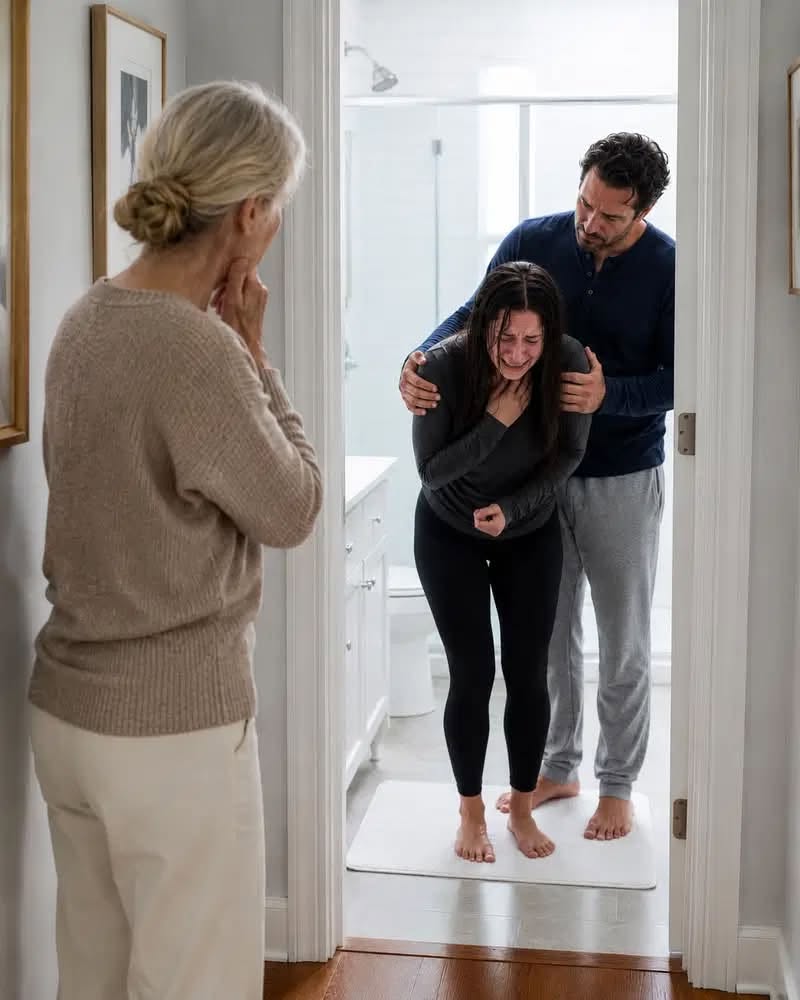
My feet felt nailed to the floor. I had reached the bathroom door, and by a strange twist of fate, it wasn't completely closed. A narrow crack remained, just wide enough to allow me to see inside.
Trembling, I leaned against the wall to steady myself and slowly looked closer at the crack.
The scene inside suddenly flashed before my eyes, and my entire body froze. My breathing stopped.
Under the bright white light of the bathroom, my son Nicholas stood there, fully dressed in his pajamas, but soaking wet.
And in front of him, under the rushing cold water of the shower head, was Hazel, also fully dressed in her pajamas, soaking wet, her long hair plastered to her pale face.
Nicholas gripped her hair tightly with one hand, pulling her head back and forcing her to endure the icy water. His face, the face of the son I had raised, now bore the same cold, cruel anger I had seen countless times on my husband's face.
He didn't scream. He simply held his wife tightly and with his other hand struck her violently on the pale cheek.
A loud crack sounded above the rushing water. Hazel staggered, her body weakening, but her hair was still trapped in his grip, and she didn't dare scream aloud. Only a strangled, desperate moan escaped her throat.
Her thin body was shaking violently from the cold and fear.
“Will you ever answer me again?”
Nicholas repeated, his voice tight between his teeth.
My whole world collapsed, all my suspicions, all my vague fears transformed into a stark, terrifying, bloody reality right before my eyes.
My first instinct was to rush in, scream, push my son away, protect Hazel, but in that instant a cold current shot down my spine, paralyzing every muscle.
The scene before me blurred, overlapping with another memory, a dark memory I had buried for years.
I no longer saw Nicholas and Hazel, I saw my husband, his eyes red from alcohol, grabbing my hair and pushing my head into the rain barrel in the garden.
I heard his curses, felt the piercing pain at the roots of my hair, the suffocating sensation of water entering my nose and mouth, and experienced the utter helplessness of struggling in desperation.
Pain therapy
That deep terror, resurfacing after more than a decade, was stronger than maternal love, more powerful than reason, and it was a conditioned reflex roaring in my head.
“Run. Don’t make any noise. Don’t provoke him or you’ll be next.”
My body obeyed that command, and my legs didn't rush forward, but instead, instinctively recoiled, turned, and ran.
I ran to my room in a gulp, not daring to look back, and threw myself onto the bed, pulling the covers over my head like a wounded animal looking for a hiding place, remaining there trembling, biting my lip to keep from screaming.
The water in the bathroom continued to flow, rhythmic and cruel, the soundtrack to my family's tragedy, to my own cowardice.
Then the memories came flooding back, and the hellish years I spent with my abusive husband flashed before my eyes.
The unprovoked beatings simply because he didn't like a meal or because I'd said the wrong word, and the long nights clutching my bruised body, crying silently, terrified that my son in the next room might hear me.
The mornings when I had to cover the bruises on my face with foundation before going to teach, having to lie to my colleagues that I had fallen off my bike.
For over a decade I lived like this, until the day the hospital handed him the death sentence, and the day he died of his illness, I didn't cry.
I just felt a sense of relief, as if a great weight had been lifted from me, and I thought I was free, but I was wrong.
The demon hadn't died with my husband, it had risen again, taking possession of the very son I loved most, and I had spent my entire life trying to correct him, to teach him not to follow in his father's footsteps.
But in the end, the violent blood still flowed in his veins, and I had failed completely and utterly.
Tears began to flow down my face, I couldn't hold them back any longer, and I wasn't just crying for Hazel, I was crying for my tragic life, for a mother's helplessness, for this cruel reality.
I had escaped from a cage, only to indirectly push another woman into an identical cage, a cage controlled by my son.
After a long time, the water stopped, the house became silent again, but this silence was more terrifying than the noise, full of guilt and unexpressed pain.
Pain therapy
I knew that in the next room, my son was probably fast asleep after his cleansing, while my daughter-in-law lay there alone, licking her physical and spiritual wounds.
I lay there, the tears dried, the fear vanished, and the pain subsided, leaving only a chilling clarity.
I couldn't stay here, I couldn't change my son, and I didn't have the courage to face him, to save Hazel, because I had already fought that demon once in my life, and it had drained all my strength.
I couldn't resist any longer, and by staying here I would slowly waste away in guilt and fear, so my only choice, my only way out for the rest of my life, was not this luxurious apartment, but another place where I could find peace.
The next day, I had to leave, quietly and decisively.
The night of terror gave way to an unusually clear and calm morning, and the sunlight filtered through the window, warm and pure, a stark contrast to the darkness that gripped my soul.
I hadn't slept a wink, but my mind was remarkably clear, the tears had dried, and the extreme fear and pain of the previous night seemed to have condensed into a cold, firm determination.
Pain therapy
I got out of bed, went to the bathroom, and looked in the mirror. I saw a 65-year-old woman with white hair, sunken eyes, and lines marked by pain.
But in those eyes there was no longer any submission or fear, it was the look of a person who had reached the bottom of desperation and had found the only way to survive.
I calmly prepared my last breakfast here, and the table was set as usual, but the atmosphere was suffocatingly tense, so I ate in silence, slowly and carefully.
Then I started talking to my two children.
“Nicholas, Hazel,” I began, my voice not shaking in the slightest, “I have something to tell you.”
Nicholas seemed a little impatient.
“What’s up, Mom? Come on.”
I looked my son straight in the eye, then turned to my daughter-in-law, who was staring at her plate, and pronounced every word clearly.
“I thought about it all last night and I decided that I will go and live in a retirement home.”
Both were stunned, and Nicholas was the first to react, his apparent calm crumbling.
"What? A retirement home? Why? Your son is right here, and you have everything you need in this big house, so why do you want to move there? Do you want people to talk behind my back? I don't approve."
I knew that his objection did not stem from love, but from pride and selfishness, since he feared public judgment, he feared ruining his image as a devoted and successful son.
Hazel also looked up abruptly, her eyes wide with panic and a hint of desperate pleading.
“Mom! Mom, have we… have we done something wrong that’s made you unhappy? Please, Mom, don’t leave. Stay here with us.”
“It’s not your fault. This place is wonderful. But I’ve realized that city life isn’t for me, and I want you two to have your privacy. Newlyweds need their own lives, and being here is an inconvenience to me. Besides, I’ve done some research. Today’s retirement homes are very nice, like little resorts. There are many friends my age, book clubs, chess clubs, and gardens I can tend to. I think I’d be happier with that kind of life. It’s more suited to an older woman like me.”
Nicholas continued to protest vehemently, but his arguments were limited to fear of losing face and being seen as irresponsible, and I simply listened in silence, letting him vent his anger.
When he finished, I looked at him with a resolute tone.
"I've made my decision. This is my life, and I want to spend my final years my way. There's no need to say anything else."
The unshakeable determination in my eyes seemed to take Nicholas by surprise, accustomed to giving orders, to imposing his will, but today he had come up against an insurmountable wall.
He looked at me, then at Hazel, and then fell into a sullen silence as Hazel began to cry, tears streaking her foundation.
"Mother…"
I reached out and gently took her cold hand.
"Hush, little girl, don't cry. You can come visit me on weekends. That'll be enough."
That morning I packed my bags by myself, just a few clothes and books, just like when I arrived.
Nicholas had already called and booked a room in a luxury retirement home on the outskirts of the city, perhaps to assuage his guilt and save face.
As I headed for the door with my suitcase, I took one last look around the apartment, a place of luxury and beauty, yet so cold and full of pain.
Pain therapy
I looked at my son, the child in whom I had placed all my hopes, now reduced to an empty shell with a corrupted soul, and it filled me with a deep, indefinable sadness.
I looked at my daughter-in-law, fragile and pale, hiding near the door, her eyes full of despair.
Life in the retirement community was so peaceful it seemed almost unreal, without harsh words, slamming doors, and most importantly, without the sound of a shower running at 3 a.m.
Each day passed with a predictable rhythm: morning exercises, breakfast with new friends, reading in the library, and afternoon walks in the sun-kissed garden, and I had found the physical security I was looking for.
But my soul was not at peace.
Every time I closed my eyes at night, the image of Hazel's soaked hair, her pale face, and her desperate eyes would come back to haunt me, and the sharp sound of my son's hand hitting his wife's face still rang in my ears.
The peace I had found here had been won through the suffering of my daughter-in-law, who had turned this place into a prison of guilt, and I had saved myself, but I had abandoned another soul who was slowly sinking into hell.
One afternoon, as I sat quietly on a stone bench in the garden, a familiar voice called to me.
“Excuse me, are you Neala, the English teacher?”
I looked up and immediately recognized Sigrid, a former colleague of mine who had retired from work a few years before me, and hadn't changed much, still retaining the same warm smile and bright eyes.
This unexpected meeting eased my loneliness a little, and we enthusiastically inquired about each other's health, talked about our children, and reminisced about old times.
Just then, a young woman with a delicate face, but a deep sadness in her eyes, approached.
“Mom, I brought you some fruit.”
“This is my daughter, Leah,” Sigrid introduced her. “Leah, say hello to Mrs. Neala.”
Looking at Leah for a moment, I saw in her a reflection of Hazel: the same submissive attitude, the same forced smile that tried to hide an inner weariness.
After Leah said goodbye and left, Sigrid sighed, watching her daughter walk away with a pained expression, and seeing my expression, Sigrid seemed to sense something.
Pain therapy
“Neala, you seem to have a lot on your mind. Even here, you can't find peace, can you?”
His words were like a key that opened the emotional floodgates I had kept tightly closed, and guilt, fear, and a sense of sin poured out.
I told her everything, without holding anything back, and I told her about my successful but brutal son, my pathetic daughter-in-law, the horrible scene behind the bathroom door, and my own cowardice.
Sigrid listened in silence, and when I finished, there was no trace of reproach in her eyes, only compassion, as she took my hand and stroked it gently.
“You’ve been through too much,” she said, her voice filled with compassion. “Hearing your story reminds me of what happened to my Leah.”
Then she began to tell me her daughter's story, as Leah had also been a victim of an abusive marriage: her husband was an educated and seemingly kind man, but in private he was a monster.
“At first, I was just as naive,” my friend Sigrid said, shaking her head regretfully. “I always told her, ‘Honey, as a wife, you have to be patient with your husband. That’s how you keep a family together.’ I thought her patience would change him, but I was wrong. I was very wrong.”
He explained that Leah's submissiveness only made her son-in-law more aggressive, escalating from verbal abuse to pushing, and finally to actual beatings.
One day, Sigrid's voice changed.
"He came home with a black eye. But what shocked me wasn't the bruise. It was his eyes. They were no longer sad, no longer in pain. They were empty. The eyes of someone whose spirit had died."
Pain therapy
At that moment, I realized I couldn't keep making mistakes.
Tears streamed down her face.
"I cried and apologized to my daughter. I told her she had to get a divorce, that she had to escape that hell at all costs."
Leah's divorce was incredibly difficult.
Her husband constantly threatened her, psychologically terrorized her, telling her that she would ruin her family's reputation if she left him, but this time, with her mother by her side, Leah found the strength, hired a lawyer, gathered evidence, and fought a tough battle in court.
Eventually, Leah was free.