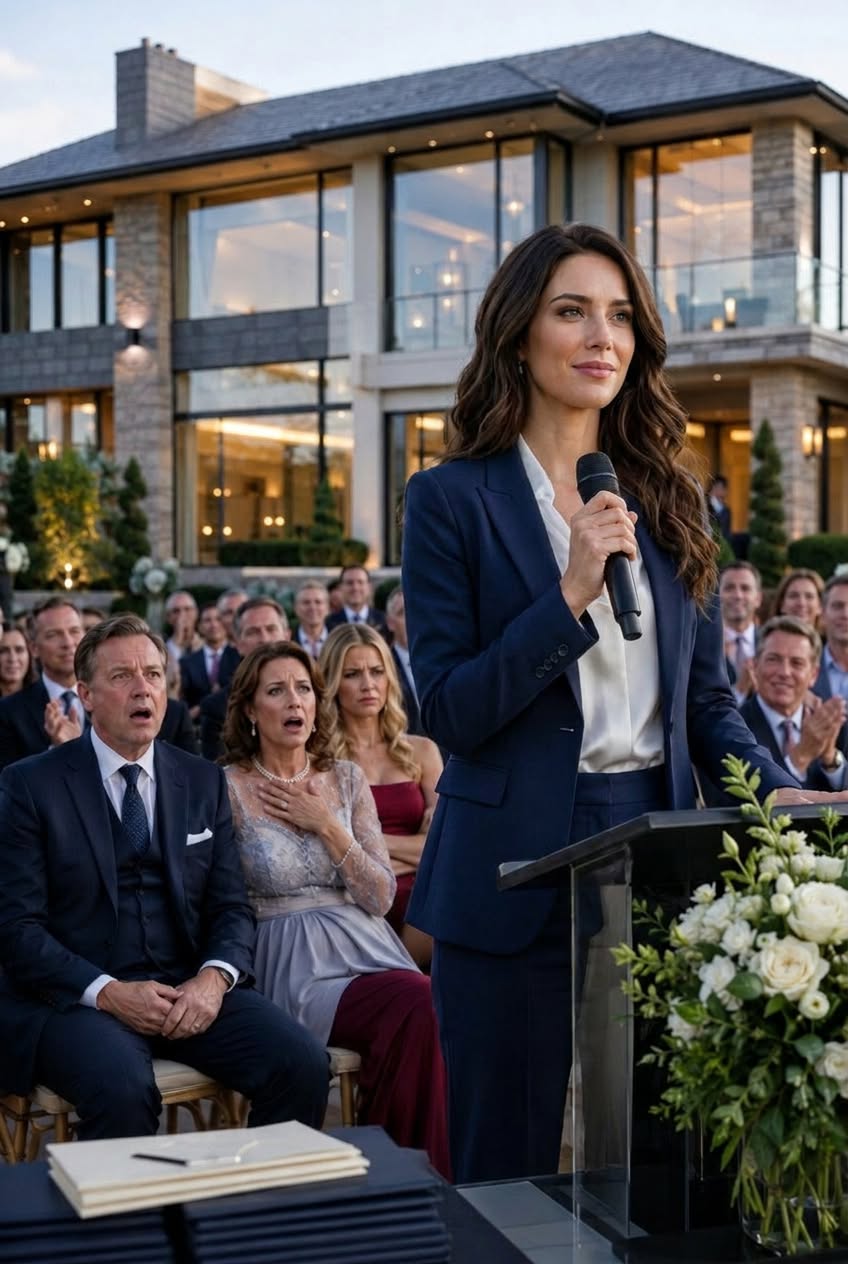
My parents left the gala before dessert was served.
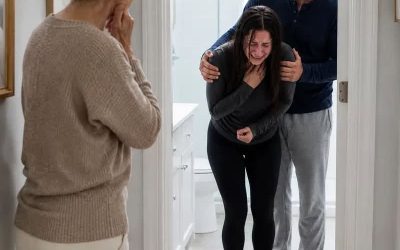
Maria told me about it later, because I hadn't asked. Apparently, Mom cried while waiting in the coat check. Dad argued with the valet. Leah was sitting in the back seat of their car with both hands on her stomach, staring straight ahead.
For three days no one showed up.
On the fourth day, Leah did it.
Not via text message.
She came to my office.
My assistant called from the front desk. “There's a Leah Coleman here. She claims to be your sister.”
I looked at my calendar. Back-to-back meetings. Investor conference calls. Product reviews. Legal briefing.
For years, I'd made myself available whenever they needed something. Old Daisy would have stopped everything.
The new Daisy checked the time.
“I have twelve minutes,” I said.
Leah entered wearing a camel-colored coat and no makeup. Pregnancy had softened her face, but stress had created dark circles under her eyes. She looked around my office as if still trying to reconnect with the sister she remembered.
“You really built all of this,” she said.
"YES."
She sat down uninvited. Typical Leah. But this time, it didn't irritate me. It just made me realize something.
“I’m not here to ask for money,” he said promptly.
"All right."
She flinched.
For a moment, neither of them said anything.
Then Leah's eyes filled with tears. I braced myself. Tears had always been her currency. In our family, when Leah cried, the world fell back together around her.
But this time, he swept them away before they could fall.
“I didn’t know that,” he said.
I waited.
"I mean, I knew they were treating us differently. Of course I did. But I told myself it wasn't my fault."
“It wasn’t your fault they favored you.”
His mouth was trembling.
“But it was my fault if I liked it.”
That sentence took me by surprise.
Leah looked down at her hands. “I liked being special. I liked being the one they believed in. And every time you pulled away, I told myself you were cold, or jealous, or dramatic, because it was easier than asking me why you had to pull away in the first place.”
There was absolute silence in the office.
"I'm not asking you to forgive me today," he said. "I don't think I deserve it. I just wanted to say I'm sorry. For dinner. For Paris. For all the times I saw you disappear and thought it was just your personality."
Some apologies come with a plea for comfort.
Not this one.
This made it harder to ignore.
I looked at my sister and, for the first time in years, I didn't see the favorite daughter. I saw a woman trapped in a role that had rewarded her but was slowly ruining her.
“Thank you,” I said.
She nodded, crying silently.
“My gallery is going bad,” he admitted. “Mom and Dad keep telling me to ask you for a loan. I told them no.”
“Did you do it?”
"YES."
"Why?"
Leah gave a small, cracked laugh. “Because after the gala, I finally realized how bad it was going to be.”
I leaned back in my chair.
Beyond my office window, downtown Seattle moved under a pale sky. Cars. People. Weather. Life unfolded without permission.
“What will you do?” I asked.
“I don't know. Maybe shut it down. Maybe teach. Maybe stop pretending that every dream is noble just because it's mine.”
It seemed like the first truly honest thing she'd ever said about herself.
Before leaving, he stopped in front of the door.
“Mom thinks you humiliated her.”
“I told the truth without naming him.”
“This made the situation even worse.”
"I know."
Leah almost smiled.
Then he added: “Anyway, your fund is splendid.”
After she left, I sat alone for a long time.
Forgiveness didn't come like dawn. It didn't flood the room with gold. It didn't erase what had happened or make me want to return to family dinners.
But something small has loosened.
Not for my parents.
For myself.
Two weeks later, Dad sent an email.
Margherita,
His speech at the gala caused his mother great pain. While I understand he may harbor old grudges, publicizing private family matters was completely unnecessary. We hope he reflects on the consequences of his choices.
Pain therapy
I read it over breakfast and felt the old coldness creep back into me.
Old grudges.
What he called a lifetime of emotional accounting errors.
I answered in three sentences.
Dad,
I've been reflecting on the impact of my choices. I learned to do so by watching you and Mom reflect on yours. I wish you all the best, but I won't discuss money or the past with you unless it's about taking responsibility.
He didn't respond for twenty-seven days.
When he finally did, the email was shorter.
We are sorry that you felt abandoned.
I deleted it.
Not because I was mad.
Because "I'm sorry you felt bad" isn't an apology. It's a locked door pretending to be open.
Life continued to go on.
The Invisible Investment Fund received over nine hundred inquiries in its first year. I read many of them myself late at night, sitting under the framed bus pass in my home office.
Girls from small towns. Girls living in overcrowded apartments. Girls whose brothers paid for their athletic training, while their robotics components came from the garbage cans. Girls whose teachers called them brilliant, but whose families insisted that engineering wasn't a feminine pursuit, wasn't emotional, wasn't impressive.
One of the nominations came from a 17-year-old from Tacoma named Maya Reed.
She had built an inexpensive sensor system to help seniors remember to take their medications. Her father called it "a nice hobby." Her mother told her not to get her hopes up about college.
His essay concluded: I don't need someone to save me. I need someone who believes that work is real.
I financed it first.
At the scholarship ceremony, Maya's hands shook as she accepted the award. Her mother wept from the front row. Her father looked stunned, as if seeing his daughter clearly for the first time.
After that, Maya hugged me and whispered, “I thought no one noticed.”
I held her tight for a second longer than I intended.
“Yes, I did,” I replied.
And that's when I understood something that money had never taught me.
The opposite of negligence is carelessness.
This is an acknowledgement.
PART 7
Five years after the dinner in Paris, I returned to my parents' house for the first time.
Not for money.
Not for reconciliation.
For a funeral.
Mr. Bell, my old landlord, had died in his sleep at eighty-one, and his memorial service was held in a small church not far from the neighborhood where I grew up. After the service, I found myself driving through streets I hadn't seen since the night I'd left in the rain.
The old house appeared on the horizon behind the maples, smaller than I remembered and less imposing than my fear had made it appear.
I parked across the street.
I don't know why.
Perhaps grief brings us to visit old ghosts. Perhaps closure isn't a door that opens, but a corridor we continue to walk until nothing reaches us anymore.
Pain therapy
The porch light was on.
For years, that light had been home to everyone except me.
I was about to leave when the front door opened.
My mother came out of the house with a small garbage bag in her hand. She looked older. Not dramatically, not tragically, just more mature. Her hair was more gray than brown. Her shoulders had narrowed.
He saw my car.
For a long moment, we looked at each other from one side of the street to the other.
Then she came closer to me.
I rolled down the window but stayed inside the car.
“Daisy,” she said.
"Mother."
She held the garbage bag awkwardly, as if she had forgotten she was holding it.
“I heard about Mr. Bell. Leah told me. I'm sorry.”
"Thank you."
Silence.
Not the tense silence of my childhood. Not the stunned silence of the gala. Just an ordinary silence between two people whose jokes had run out.
My mother looked at my car, my coat, my face. “You look good.”
"I am."
“Sometimes I see the girls who received your scholarship on the news.”
“They're not my girls.”
“No,” she said softly. “I suppose not.”
That answer surprised me. There was no argument in it.
He looked down at the sidewalk.
“I found something last month,” he said. “Cleaning out the attic.”
I waited.
“Your science fair ribbon. The blue one. Solar charging station, right?”
I immediately remembered the tape. Fifteen years. Six months of work. A gym full of folding tables. First place. My mother saying, "That's great, Daisy," before asking me if I'd heard of Leah's essay.
“Yes,” I said.
“I should have framed it.”
The sentence was light.
Too small for his age.
But it was the first time he talked about something concrete.
“Yes,” I said. “You should have.”
Her eyes were full of tears, but she didn't ask me to console her. And that was important.
“I don’t know how to make up for what we did,” he said.
“You can't fix it.”
He nodded as if he had already expected that answer.
"I know."
We sat in silence.
A neighbor's dog was barking somewhere nearby. The wind blew dry leaves along the sidewalk. The house behind him no longer looked like a monument. It looked like a building filled with people who had made irreversible choices.
“I’m not coming back,” I said.
"I know."
“I won't give money.”
"I know."
“I won’t pretend everything was okay.”
A tear rolled down her cheek.
“I know,” he repeated.
For the first time, my mother didn't try to defend herself.
This didn't cure me.
But it made the moment perfect.
He reached into his coat pocket and pulled out a small envelope.
"I was about to send it to you," he said. "But since you're here..."
I didn't accept it right away.
“What is it?”
“A picture of you with the ribbon. Your father took it. I don't remember ever seeing it before.”
I took the envelope.
My mother took a step back.
“Goodbye, Daisy.”
“Goodbye, Mom.”
I drove off before she could get back to the porch.
At home, sitting in my glass-walled living room, as the rain pounded the city, I carefully opened the envelope.
Inside was a photograph of me, fifteen, standing in the school gym, holding a blue ribbon almost as wide as my chest. My hair was pulled back in a ponytail. My smile was uncertain, as if I were asking permission to be proud.
Behind me, blurry but visible, my parents were talking to another couple. They weren't looking at me.
For a long time, I stared at that girl.
Then I took the photo to my office.
I didn't replace my bus pass.
The bus pass remained exactly where it was.
But next to it, I put the photo of the girl with the ribbon.
Not because my mother had finally found it.
Because I did it.
The following years were not dramatic. This is the part of the healing process that people rarely understand. They expect slammed doors, heated arguments, a final conversation that puts the pieces of a life back together.
True freedom is quieter.
TrailSync expanded across the country. The Unseen Investment Fund became a foundation. Maya Reed became one of our youngest engineering fellows and went on to start her own company. Leah closed her gallery and became an art teacher at a public high school. To everyone's surprise, including herself, she loved it.
Sometimes we heard from each other.
Not like sisters in the movies. Not with late-night secrets and matching pajamas for the holidays. But with care, honesty, without pretense. Her daughter, Emma, sent me drawings of robots with wings. I responded with science kits and books with inventors on the covers.
My parents kept their distance.
My father never gave me the apology I wanted. My mother came closer, then she moved away, then she came closer again. I stopped comparing them to what I'd needed as a child. That little girl deserved more, but she was no longer there waiting for me at the end of the table.
Every year, at the scholarship ceremony, I told the same story in different words.
That's not the whole story.
These are not my parents' names.
Exactly this:
Someone once told me I didn't deserve help.
For a while, I thought that sentence was about my worth.
It wasn't.
It was about their limitations.
This is the truth I wish every forgotten daughter could learn sooner. Others' inability to love you properly doesn't mean you're difficult to love. Their refusal to invest in you isn't proof you're a bad investment.
Sometimes, people who ignore you are simply too close to the wrong light.
And sometimes, when you finally leave, soaked in the rain, carrying nothing but a bus pass and a broken heart, you're not losing your family.
You are finding your way back to yourself.
I still live in the glass house overlooking Lake Union.
When it rains, I make myself coffee and listen.
Rain no longer sounds like rejection.
It seems to be a question of distance.
It feels like peace.
It sounds like the voice of a girl at the end of the table who gets up, folds her napkin and finally understands that she was never a reject.
She was the return.