Mike's clothes were simple: an orange prisoner's uniform, ill-fitting and faded, nothing that distinguished him – except the man hiding behind it. He lowered his head, not out of submission, but out of conscience. Over the years, he had learned to read a room, to understand its atmosphere, to anticipate the inevitable confrontation. But here, the tension was palpable, each look charged with silent calculation.
Mike's mind was racing. Who ran this garden? Who held the power, and what was their bargaining chip: fear, violence, reputation? Every detail counted. In prison, hierarchy was a living and palpable reality. Understanding it could mean the difference between life and death. He knew that to survive, he must first observe, then act, and always remain steadfast.
Eyes glued to the target
. It didn't last long. Within minutes, Mike felt the undeniable weight of someone targeting him. Not a trivial look, but the careful and predatory examination of someone who wanted to know if they would break down or if they would defend themselves.
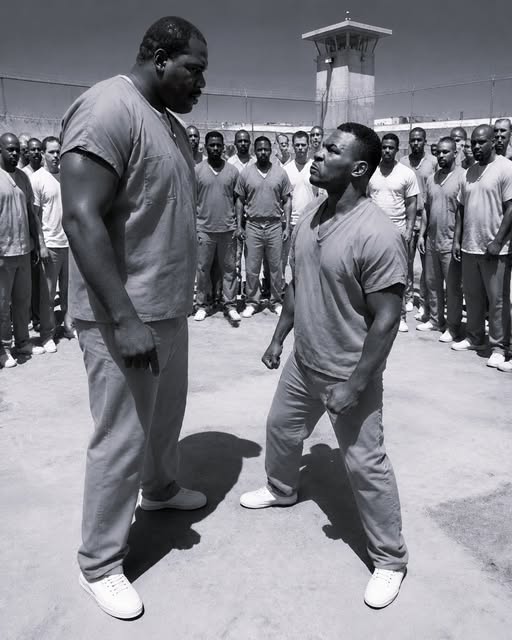
He looked up and saw a giant – 1.95 m tall, muscles bulging and tattooed, his face marked by a life of fighting – slowly advancing towards him. Behind him, four other men imitated his movements, shadows of loyalty and intimidation.
The rest of the ground instinctively cleared. Everyone knew what was going to happen. It was a test, a ritual of domination. Mike Tyson, despite his legendary status, would have to prove himself once again – not by fame, not by money, but by his presence, his lucidity and the subtle but powerful language of fearlessness.
Every step of the approaching man made the concrete floor vibrate. The court held its breath. The moment stretched, suspended between waiting and action.
First movement.
The giant stopped a meter and a half away, his arms crossed, a hard smile on his lips. "So, you’re Mike Tyson", he said, his voice echoing through the courtyard. "A cruel master. I've heard a lot about you. I heard you knock out your opponents in seconds. "
Mike slowly raised his head. His gaze met mine without hesitation. "Yes", he said calmly, in a calm tone. "I knocked people out. It's my job. "
A palpable tension seized the onlookers. It wasn't bravado, it was affirmation. The courtyard seemed frozen, as if suspended in anticipation of the inevitable confrontation.
The giant then threw himself forward – not a full-blown attack, but a push, an ordeal intended to provoke fear. The goal was clear: to retreat, to retreat or to reveal a weakness.
Mike didn't move. He took the blow with a slight shift in weight, almost provocative, almost courageous. The crowd fell silent. The giant's smile faded.
Respect was evident in a few seconds.
In a flash, Mike's experience and instinct manifested. A feint, a pivot, a discreet but precise interception, and the giant stumbled, stunned by the spectacle. Mike didn't land a second blow. He stood, breathing calmly, his eyes closed on the man. "This is my world now", he said in a calm voice, but every word carried authority that echoed throughout the courtyard.
The crew hesitated, uncertain. Attack or retreat? The decision was instantaneous, tacit. Mike pretended to be a psychological ploy, without dealing the slightest blow. In a few seconds, respect was acquired.
The evolution of prison dynamics.
From that day on, the dynamics of the shipyard changed subtly. Whispers replaced challenges, caution replaced provocation. Mike's name was no longer just a legend on the outside; he had a tangible presence within these walls.
The men who had tried to put him to the test now observed him from afar, analyzing, reconsidering their position. He had decided that outward glory had no importance here; only talent, composure and self-control mattered.
Every day reinforced this lesson: in this environment, survival required more than strength. It required consciousness, perception and the silent but undeniable power of presence.
Observation and learning.
Mike spent his first week in the general population scrutinizing the court like a master observing a chessboard. He noticed the alliances, rivalries and unspoken codes that governed behavior. Every conversation, every look, every little gesture had meaning.
He began to spot subtle clues about those exerting influence, not only through force, but also through trickery, intimidation, and respect. Little by little, he positioned himself strategically, allying himself with those whose presence offered him protection while maintaining enough independence to avoid getting bogged down in conflicts that were not his.
Psychological game.
The imprisonment was not only physical, but also psychological. Mike knew that intimidation, reputation and perception often trumped brute force. A well-placed look, a calm reaction, even silence, could say more than words or actions.
By the end of the first week, the shipyard had accepted a new reality: Mike Tyson was no longer a stranger. It was an integral part of the ecosystem, and its presence required caution, respect and curiosity.
Survival beyond strength.
What Mike demonstrated was a lesson in the art of survival. Strength mattered, of course, but vigilance, patience and mental acuity were just as important. Every decision had consequences, every action could be interpreted as weakness or a show of strength.
Through observation and restraint, Mike was able to find his way through the hierarchy, understanding that fear was a bargaining chip, respect was earned, and that strategy could protect him more effectively than aggression alone.
The legend continues.
In the Indiana prison yard, the legend of Mike Tyson has transformed into a new story: not one of fame or fame, but one of adaptation, intelligence and survival. Just a few minutes after his arrival in this hostile environment, he was able to stand up, not through raw violence, but thanks to the presence, confidence and calm of a man who had faced the most formidable adversaries in the world and emerged unscathed.
It was much more than just a fight story. It was a demonstration that instinct, experience and unwavering mental strength could command respect, even in the most unforgiving arenas.
The strength of presence and consciousness.
Mike Tyson's early days among the general population were a true lesson in observation and mental strategy. Beyond the physical confrontations, the real challenge was understanding the invisible rules that governed this universe. Every look, every silence, every little gesture had meaning. These men communicated through subtleties imperceptible to strangers, and to survive, Mike had to decipher them.
He quickly understood that the prison was a microcosm of the streets he had left, increased tenfold. Reputation was a bargaining chip, fear a weapon, and perception could mean the difference between life and death. By observing carefully, he learned who exerted influence through brute force, who manipulated through intimidation, and who relied on trickery and alliances to survive. His past as a warrior –accustomed to deciphering the movements of his opponents and exploiting their flaws – gave him an advantage, but the stakes here were much higher: a single mistake could degenerate into violence, injury, or worse.
What distinguished Mike, however, was neither his skill nor his instinct, but his presence. The way he moved, his posture, the calm and firmness of his gaze conveyed a tacit message: he was conscious, he was capable and he would not let himself be intimidated. The other prisoners felt it immediately. The respect, once dearly acquired over months, even years, changed in a matter of minutes. The court, which had seemed to him a foreign and hostile world, gradually adapted to his presence. Mike became both an observer and an actor, a character whose story outside the walls was only part of the story; his actions within determined the true measure of his power.
Through his patience, lucidity and quiet mastery, Mike Tyson has demonstrated that survival in the most hostile environments relies as much on mental strength as on physical abilities. He didn't need to prove his strength in battle: he proved it with his charisma, his strategy and the unwavering confidence of a man who knew he could meet any challenge and remain undefeated.