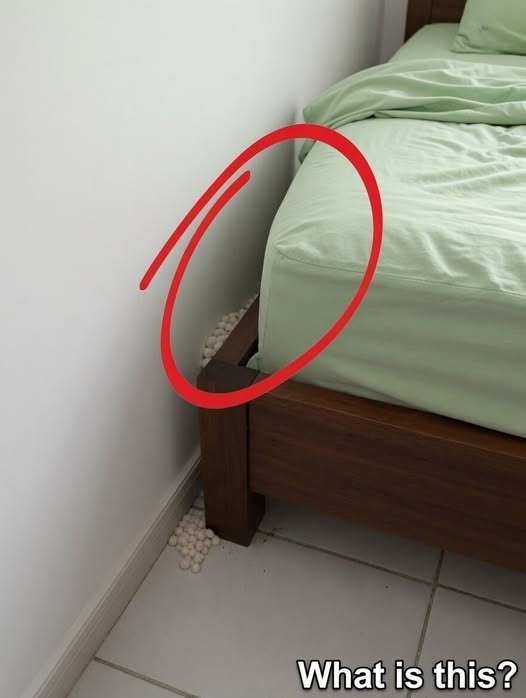
Coming home after a long day at work, longing for just a good night's rest... and stumbling upon something strange near his bed. This is exactly what happened to an Internet user who shared her discovery, triggering an avalanche of reactions. Small, mysterious white spheres placed there, near his headboard. What is this? Should we be worried? We explain everything to you.
These little white balls near the bed: the first reaction is always the same
Fear. Immediate, instinctive. We see something unusual in a place we thought we knew perfectly well, and the brain races. However, once calm returns, observation takes over. And there the question becomes fascinating: where do these little spheres come from? Who put them there?
The answer most often mentioned by Internet users: lizard eggs, presumably laid by a domestic gecko.

Why would a lizard choose precisely the space near your bed?
It's no coincidence. Domestic geckos are much more strategic creatures than we imagine. When a female looks for a place to lay eggs, she evaluates several essential criteria: heat, darkness, protection and humidity.
The space between a bed and a wall ticks all of these boxes. A mattress retains body heat from those who sleep on it, creating a stable, gentle temperature all around. Darkness reigns in these little-explored corners. And the slightly higher humidity than the rest of the room protects the eggs from drying out.
Add to this that rooms often attract insects, attracted by light or human warmth. For a gecko that feeds on mosquitoes and small midges, this is an ideal pantry. Staying close, then laying eggs nearby, then becomes perfectly logical.

But be careful: are these really lizard eggs?
This is where the story becomes even more interesting. A female gecko usually lays eggs one to two eggs at a time, never dozens of perfectly identical spheres. Real gecko eggs have a slightly calcareous or leathery shell, they are not perfectly round, and they often stick to a surface.
If the exposed spheres are perfectly uniform, very numerous and resemble small plastic or foam balls, there is another much more banal explanation: polystyrene balls or microbeads from a torn pillow, cushion or carrying bag.
One test is enough: examine one of them closely. Slightly irregular natural shell? More like eggs. Perfectly smooth and synthetic surface? Head to the trash can and replace the pillow.

Should you be concerned if a gecko lives in your home?
Honestly, no. Domestic geckos are completely harmless. They do not bite, transmit anything and even prove to be valuable allies against mosquitoes and other small unwanted insects.
If you spot small eggs stuck in a discreet corner, it is better to simply move them outside and check for any openings through which the lizard has entered.
Nature is sometimes much closer to us than we think — even a few centimeters from our pillow.