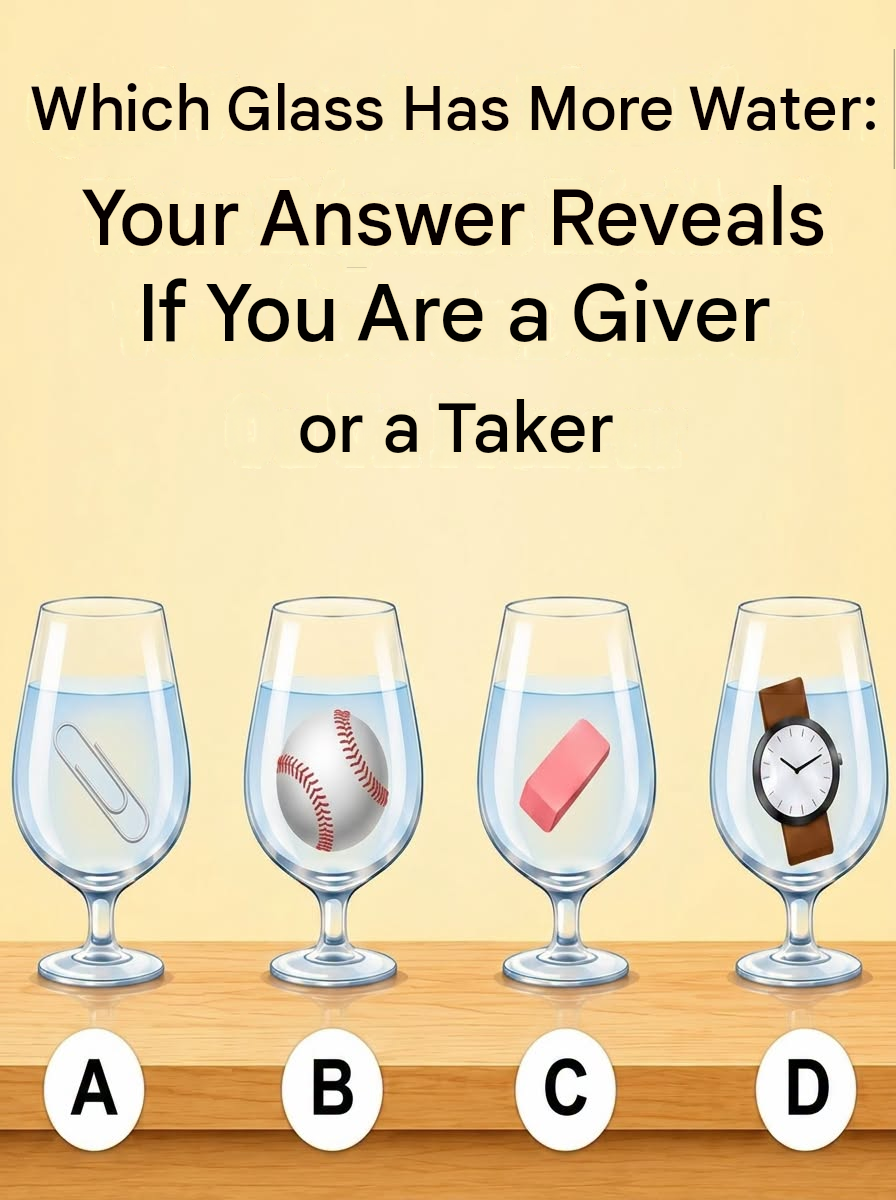
Four glasses, four objects, one question: which one contains the most water? At first glance, the answer seems obvious. So obvious, in fact, that we rush headlong... and make mistakes almost every time. This little visual puzzle has been panicking the networks for several weeks, and for good reason: it hides a physics lesson that many of us have forgotten since middle school. So, ready to take on the challenge?
What you see... and what deceives you
Let's imagine the scene: four identical glasses, labeled A, B, C and D. They appear filled to exactly the same level. However, each contains a different object — a paper clip in glass A, a baseball in B, an eraser in C, and a watch in D.
At first glance, it is naturally assumed that all glasses contain the same amount of water. Logical, right? The levels are the same, the glasses are identical... Except that's exactly where the trap closes.
Physics to the aid of your logic
The secret of this enigma is based on a very simple scientific principle: the water movement. When you immerse an object in a liquid, that object takes up space and repels a certain amount of water. The larger the object, the more space it takes up... and the less water remains in the glass.
In other words: a large object = less real water, even if the apparent level seems the same.
So which drink wins?
The answer is glass A — the one with the trombone. Quite simply because the paper clip is by far the smallest object of the four. It takes up minimal space, leaving as much water as possible inside the glass.
Conversely, the baseball in glass B moves a lot of liquid. The D glass watch is also quite bulky. And the rubber of the C glass, although discreet, takes up more space than the tiny paper clip.
Moral of the story: it's not what we see that counts, it's what we don't see.
What if your choice said more about you?
The really fun part starts here. Because beyond the correct answer, this puzzle also reveals your way of thinking — and it is often surprising in its accuracy.
– Did you choose A (the trombone)? You are analytical, you notice details that others ignore. You are easily recognized by your sense of observation. – Did you choose B (the ball)? You trust your instinct, you decide quickly and confidently. Energy and spontaneity are your superpowers. – Did you choose C (the eraser)? You balance logic and creativity with naturalness. You like to explore all avenues before deciding. – Did you choose D (the watch)? You think deeply, you seek the hidden meaning of things. They say you are intuitive and imaginative.
Of course, it's all still a game. But let's face it: it always makes you think.
Why these puzzles captivate us so much
These little visual puzzles have incredible power: they force us to question our certainties, to look beyond appearances and to slow down in a daily life where we often go too fast.
What if the real lesson was just that — take the time to observe before concluding?
The biggest revelations are often hidden in the smallest details.