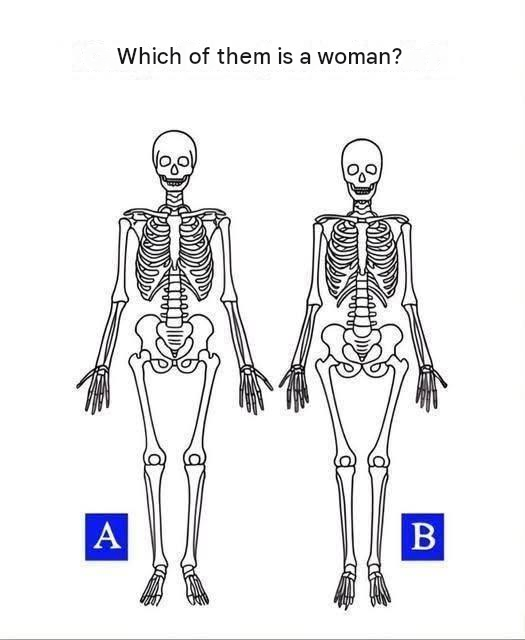
Can you tell which skeleton belongs to a woman?
At first glance, the two skeletons in the photo appear almost identical. Many believe it's impossible to determine whether a skeleton belongs to a man or a woman simply by looking at it.
However, in reality, qualified experts, such as anthropologists and forensic pathologists, can often determine the sex of a skeleton with surprising accuracy.
The secret lies in some parts of the human body, particularly the pelvis.
Why is the pelvis important?
The pelvis is the most reliable bony structure for determining the biological sex of a skeleton.
This is because the female body is designed for childbirth, which means the pelvis is typically wider and shaped differently than the male one.
A female pelvis typically features:
A wider pelvic opening
A more rounded shape
A wider hip structure
Male skeletons typically have a narrower, V-shaped pelvis.
While the pelvis is the most obvious difference, scientists also consider other bones.
For example:
Shoulders:
Male skeletons often have broader shoulders.
Skull shape:
Male skulls are typically thicker and more angular.
Bone density:
Men's bones are generally slightly heavier and thicker.
However, these differences are not always easy to spot for the uninitiated.
Looking at the image
If you look carefully at the skeletons in the image, you may notice that one of them has a wider pelvis and more curved hip bones.
This skeleton is most likely that of a female.
The other skeleton has a narrower pelvis, more typical of male anatomy.
Why these puzzles go viral
Images like this spread quickly on social media because they test people's observation skills.
They prompt them to pause, think carefully, and comment on their hypotheses. This interaction is precisely why these posts often receive thousands of comments.
Final question
Now that you know the secret, look at the picture again.
Did you guess right the first time?
To continue reading, click (NEXT) below!