Unlike aluminum or copper oxides, iron rust does not form a protective passivation layer. The oxide layer is porous and crumbly, allowing further oxygen and moisture to penetrate to the deeper metal layers beneath. This causes corrosion to progress continuously until the component is structurally damaged.
The Experiment in Detail: What Role Do the Components Play?
In viral experiments, four main components are typically combined: a magnet, aluminum foil, an aqueous electrolyte solution (such as salt water or baking soda), and the rusted iron object. But what physical function does each element perform?
1. Aluminum as the Anode (Sacrificial Metal)
Aluminum is a less noble metal than iron. In the electrochemical series of elements, aluminum has a standard potential of approximately -1.66 volts, while iron is at approximately -0.44 volts. When aluminum is brought into contact with rusted iron via an electrolyte (salt water) and a conductive connection, a so-called galvanic cell (local cell) is formed. The less noble aluminum acts as the anode and releases electrons (oxidation), while the more noble iron acts as the cathode and accepts electrons.
2. The Electrolyte as an Ionic Conductor
Pure water is a very poor conductor of electricity. Only through the addition of salts (such as sodium chloride, NaCl) or hydrogen carbonates do freely moving ions (Na+ and Cl-) form. This electrolyte enables the transport of electrical charge between the aluminum and the rusted workpiece, thus closing the circuit.
3. The Magnet and the Lorentz Force: Fact vs. Myth
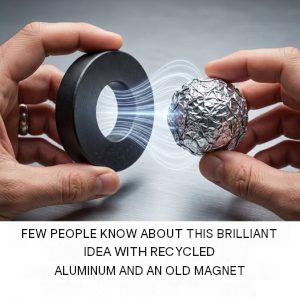
This is where the greatest confusion arises in the viral videos. A static magnetic field, in itself, does not trigger the chemical reduction of rust. A magnet cannot magically convert iron oxide back into elemental iron. Nevertheless, in the experimental setup, the magnet fulfills two real, limited functions:
Haptic contact: A strong neodymium or ferrite magnet, through its magnetic force, ensures a firm, continuous contact pressure between the aluminum foil and the workpiece, which reduces the electrical contact resistance.
Lorentz force and micro-convection: When an electric current (the charge migration of electrolysis) flows through a magnetic field, the so-called Lorentz force acts on the charged ions in the electrolyte. This leads to slight turbulence or flow in the liquid near the surface (magnetohydrodynamics). As a result, detached particles are flushed away more quickly.
Conclusion about the magnet: The magnet is not the chemical cleaner, but merely supports mechanical contact and liquid circulation. The actual work is done by the electrochemistry between the aluminum, electrolyte, and iron.
Why viral videos often convey a false impression: Although the electrochemical effect is real, the results in social media clips are often heavily staged. Viewers should consider the following aspects:
Time-lapse and editing tricks: Electrochemical reduction or the removal of rust layers takes time—often several hours. Videos often make this process appear less significant through time-lapse or editing techniques.